
HISTORICAL
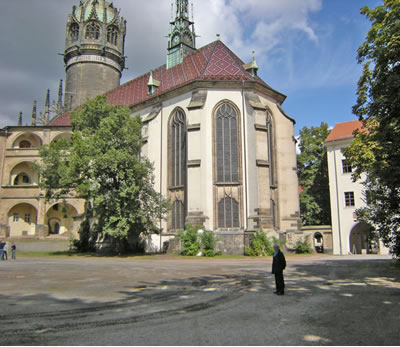
David at the Castle Church, Wittenberg
"Remove not the ancient landmark, which thy fathers have set." (Proverbs 22:28)
_____________________________________________
REFORMED DISTINCTIVES
The Reformation: the beginnings
On the 31st October 1517, an Augustinian monk, Martin Luther, nailed 95 theses to the door of the Castle Church in Wittenberg, a flame that set alight what became the Reformation. He challenged the Roman Church to demonstrate eternal life can in anyway be earned by man. In 1524 he expounded the doctrine of justification by faith alone, sola fide, in his book The Bondage of the Will. It is a touchstone of Reformed theology. Not that this teaching was previously unknown, far from it, but it had just become submerged under growing mass of superstition prevalent at that time in the Church. Luther’s teaching conflicted with the selling of indulgences through the purchase of which personal sin could be forgiven. So apart from anything else, not only did Rome see its exclusive authority to forgive sins slipping away, but also should this doctrine spread there would be an adverse effect on its revenues.
_____________________________________________
WHAT DO WE OWE TO THE REFORMATION?
Dr J. C. Ryle
Our lot is cast in days when it is the fashion to despise everything that is old. There is a morbid readiness to throw aside all things which bear about them the least mark of antiquity, and to treat them with as little respect as last year’s almanacs or worn out clothes. The only exceptions I can think of are, old lace, old coins, old pictures, and old wine! But as a general rule, old opinions and old institutions are too often condemned as useless lumber, and shovelled out of the way, simply because they are old.
____________________________________________
"History cannot be seen for what it is at any stage except it be viewed in relation to its final end."
Cornelius van Til